A written SOP is rarely ignored because it is wrong. It is ignored because reading step 14 while standing at the machine, or while a customer waits on the line, is slower than asking whoever is nearest. That is where process drift starts, and it stays invisible until an audit or a defect trend makes it visible. The sections below cover what changes once the approved procedure is rebuilt as something people watch, and which part of the maintenance burden each one takes away.
Show the real step instead of describing it
The procedure says to verify the pressure reading before releasing the clamp. The new technician has now read that sentence four times and still does not know which of the two gauges on the panel is the one that matters, or what a correct reading looks like on it. So they do what everyone does: find someone on shift who knows, copy what that person does, and put the binder back on the shelf unread.
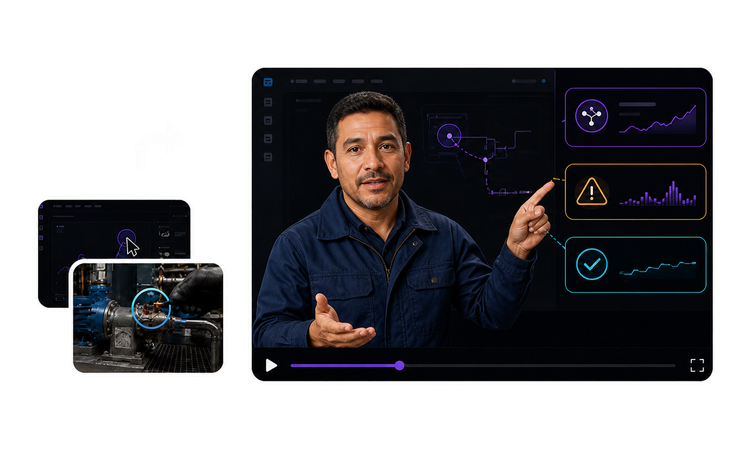
Putting the footage your own team recorded on screen with an instructor beside it closes that gap. The trainee sees the actual gauge, the actual control and the actual sequence while a consistent presenter names what is happening and where to look. VisionStory generates that presenter against a green screen; your own editor decides where the layer lands, which is how the instructor ends up at the edge of the frame rather than over the control being described.
Where video tutorial software stops and an SOP begins
Fourteen minutes into a recorded walkthrough, the technician clicks the button the video just clicked and the system answers with a dialog the recording never contained: a warning about an open batch, two buttons, no obvious right one. The narration carries on describing a screen that is no longer there. Nothing in it said what the step was for, which condition has to be true before continuing, or what to do when the system does not respond the way it did that day.
An SOP video earns its runtime somewhere else. Each step states the condition that lets you continue, the tolerance or state that counts as correct, the consequence of skipping it, and who to escalate to when the result falls outside the range. Slides carry the parts no recording can show, such as thresholds, safety warnings and exception paths. Step-by-step interface clicking belongs in a tutorial; this is the layer above it.
Find one step without opening the whole procedure
The line goes down at ten past two and the work instruction is already open on a phone: sixty pages, and somewhere inside them the three steps that clear this fault. The recorded version is no kinder, forty minutes covering the entire machine with a scrub bar and no chapter marks. The technician hunts for a while, gives up, and calls the one person on nights who has done it before.
One task per module is what makes the answer reachable. Each module covers a single procedure and carries the name the task has on the floor, plus its procedure number, so a search returns the module rather than the document it is buried in. It opens on a phone at the point of work and shows the step being performed. Small modules are cheaper to keep current too: when a step changes you rebuild the one module it touches.
Keep every plant, shift and contract crew on one approved version
The second plant runs the changeover with an extra check the first plant has never heard of, added years ago by a supervisor who had a good reason at the time. Nights inherited the task verbally from someone who has since left. The contract crew was walked through it in a language the work instruction has never existed in. Nobody is being careless, and none of it surfaces until an incident, a quality trend or an auditor makes someone reconstruct what people were actually taught.
One released master settles what every site is trained against. The same instructor, step order and approved wording go to each plant and shift, and approved editions in any of 88 languages let a crew train in the language it actually works in instead of inheriting a local retelling. Supervisors check equipment names and safety terminology in their own edition rather than authoring a site version, so the question of what people were trained on has one answer and one revision date.
Use the footage you can never film again
Some of the most valuable process footage in a company is also the worst looking: a line changeover filmed on a phone years ago, a control panel that has since been replaced, a commissioning run nobody is going to schedule a second time. The clip proves the point better than any re-enactment could, and it is soft, noisy and compressed to the point where the labels on the panel are unreadable.
Restoring that footage before it enters a module is often the difference between using it and cutting it. Enhancement clears blur, noise and compression damage without touching timing or audio, so narration written against the action still lines up frame for frame. Where a recording is genuinely beyond repair, re-shooting the step is the honest answer, because a module in which the operator cannot tell which switch was thrown teaches the wrong thing.




Users Love VisionStory
Discover why content creators and marketers trust VisionStory for their AI video needs. From powerful features to an effortless user experience, our community can’t stop raving about the results they achieve with VisionStory.