Compress JPG Images
Prepare JPEG-specific settings without mixing in PNG transparency or format-conversion tasks.
Drop JPG images here
JPG or JPEG · up to 20 files · 5 MB each
Prepare JPEG-specific settings without mixing in PNG transparency or format-conversion tasks.
JPG or JPEG · up to 20 files · 5 MB each
JPEG quality choices
Match JPEG compression settings to how the photograph will be viewed, shared, or uploaded.
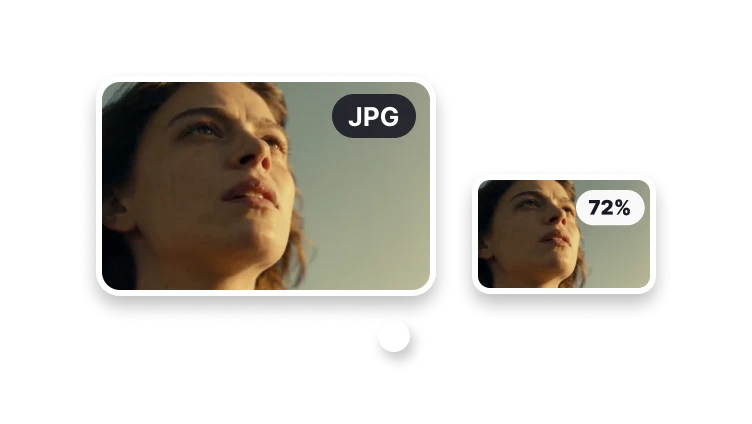
Use a higher setting when fine texture and gradients matter.
Favor a lighter file for email, forms, and quick delivery.
Prepare a JPEG that becomes clearer as it loads.
Reduce the file without turning it into another image type.
Start from the destination, then choose the JPEG tradeoff.
JPEG tradeoffs
JPEG photographs need a deliberate balance between visible detail and delivery weight. A quality preference and an exact upload ceiling are related but different constraints.
Compare fine texture, gradients, text, and edges at the final display size rather than trusting a preset name.
Use Reduce Image Size when acceptance depends on a byte ceiling; one JPEG quality value cannot guarantee it.
Keep JPEG quality and artifact tradeoffs as the page's central decision, and route neighboring compression, conversion, timing, or editing needs to their dedicated tools.
Visual diagnosis
Raise the quality goal or reduce dimensions deliberately; avoid repeatedly recompressing the last lossy output.
A noisy high-resolution photograph can remain heavy even when another image reaches a lower size at the same setting.
When JPEG quality and artifact tradeoffs cannot be confirmed, retain the best source, state the limitation, and choose a workflow with an explicit product contract.
JPEG proof
Record source dimensions, input bytes, quality setting, progressive state, output bytes, encoder version, and test date.
Present identical 100-percent detail regions so readers can evaluate artifacts instead of comparing unrelated thumbnails.
Record unsupported cases and failed checks alongside successful fixtures so JPEG quality and artifact tradeoffs remains reproducible rather than becoming a universal marketing claim.
It depends on the image and destination. Start with a moderate quality setting, inspect the real processed result in VisionStory, and adjust if visible artifacts are too strong.