Crop Images to the Exact Frame You Need
Use cropping to remove outer areas and change composition, not merely to scale every pixel.
Choose an image to crop
JPG, PNG, WebP or HEIC · up to 1 file · 10 MB each
Use cropping to remove outer areas and change composition, not merely to scale every pixel.
JPG, PNG, WebP or HEIC · up to 1 file · 10 MB each
Composition and framing
See how the same source can be reframed for square, landscape, widescreen, and vertical layouts.
Frame products, profiles, and grid posts.
Keep more height for editorial and presentation images.
Prepare covers, thumbnails, and slide visuals.
Center the subject for Stories, Reels, and mobile creative.
Choose the destination frame before deciding what the image can lose.
Export in VisionStory
The launcher prepares crop intent; VisionStory applies the operation and produces the downloadable file for final review.
The current handoff may require another selection and crop confirmation after the VisionStory workspace opens.
Check retained content, dimensions, rotation, format, bytes, and destination placement before publishing.
Approve the result only after crop geometry and subject framing is checked in the named player, editor, upload form, publishing system, or other intended destination.
Framing choice
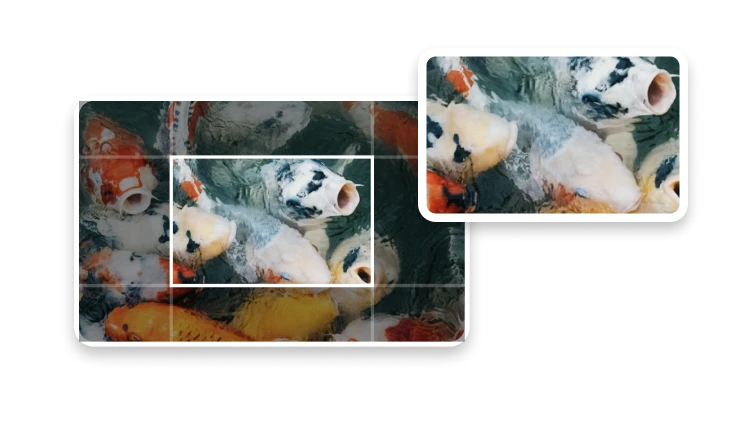
Cropping removes pixels outside a selected region. Use resizing when every part of the picture should remain visible at a different resolution.
Draw a custom frame when the composition matters more than a standardized destination shape.
Choose square, vertical, or widescreen intent before positioning the subject and checking surrounding negative space.
Keep crop geometry and subject framing as the page's central decision, and route neighboring compression, conversion, timing, or editing needs to their dedicated tools.
Crop anatomy
Aspect ratio describes the frame; pixel dimensions describe the output grid. Crop position determines which visual information survives.
Coordinates, width, height, and rotation make a crop reproducible only when the source and operation order remain known.
Check important content near every edge and account for overlays that the destination may place above the image.
Read crop geometry and subject framing from the actual source and output; do not infer technical properties from the extension, preview, or control label alone.
Yes. Cropping removes pixels outside the selected rectangle, so the resulting width and height reflect the crop region.